Google Family Link
- 4.6
- Rating
- 100.00M
- Installs
- Free
- Price

 Analysis by App-foxy
When I first tried Google Family Link, the appeal was easy to understand: it puts everyday parental controls in one place instead of making me search through several Android settings. The app is designed to help parents guide children’s use of compatible devices, and I found that its strongest quality is not a flashy feature but the way it turns scattered decisions into a routine. I can check what needs attention, adjust boundaries, and discuss changes with a child without treating the phone as a mysterious black box.
That convenience matters most during the first week. Setting up a family arrangement still requires patience, and the experience depends on the child’s device, account situation, and the controls a parent actually wants to use. Once the initial work is complete, though, the app feels much more approachable than manually inspecting every setting. It is a free tools app from Google LLC, available for users aged Everyone, and it supports devices running Android 7.0 or later.
What Family Link feels like after the first week
The first useful habit is opening the app with a question in mind rather than browsing it aimlessly. I might want to know whether a child is spending too much time on a particular kind of activity, whether a device needs a bedtime boundary, or whether an app request deserves a conversation. That approach keeps Family Link from becoming a constant surveillance dashboard. It works better as a place to make deliberate adjustments.
You May Also Like

 Blood Strike: 2.5 Anniversary
Blood Strike’s Loadouts Turn Every Drop Into a Tactical Gamble
A close look at Blood Strike’s custom loadouts: how fast access to signature weapons reshapes its battle royale rhythm, rewards preparation, and narrows the gap between fights.

 Pandora - Music & Podcasts
Pandora’s Music Is Easy to Start, but Harder to Recover
Pandora’s strength is its low-effort path from a seed to a station. Its weak spot is how much confidence it asks you to place in connection, setup, and quiet recovery.

 8 Ball Pool
 Is Built on Rivalries, Rematches, and Routine
A close look at the rivalries, rematches, shared routines, and unanswered safety questions that turn a quick pool match into a persistent mobile community.

 Samsung Music
’s Quiet Strength Is Playing What You Already Own
Its reach comes less from spectacle than from dependable access to a personal library. That simplicity is both the app’s strongest retention engine and its ceiling.

 AccuWeather: Weather Radar
AccuWeather Review: A Quick, Clear Forecast for Everyday Decisions
For everyday plans, the best forecast is the one you can understand quickly. AccuWeather makes rain timing, radar, and local conditions easy to act on, with a few trade-offs.

 Hill Climb Racing
Why Hill Climb Racing Still Turns Crashes Into One More Run
A tiny car, a bumpy hill and one more upgrade: Hill Climb Racing keeps resurfacing because its simple chaos makes every near-miss feel personal.
More From Our News Desk
View All News


During setup, I would recommend deciding in advance what the family rule is supposed to achieve. A limit intended to protect sleep is different from one intended to reduce distractions during homework. If I simply activate every available control, I create more exceptions to manage later. Starting with one or two clear rules makes it easier to tell whether the arrangement is helping.
A realistic example is a child who uses a phone for school communication but keeps drifting into entertainment in the evening. Family Link can give the parent a central way to review the situation and change the routine without taking the device away permanently. The important part is the conversation around that change. The app can support a boundary, but it cannot explain why the boundary exists or settle disagreements about fairness.
One detail I found valuable is the difference between reviewing information and reacting to it. A single busy day does not automatically mean a rule has failed. I would look for a repeated pattern before tightening restrictions. This prevents the app from encouraging impulsive decisions based on one unusual afternoon.
The interface is most useful for parents who already live in Google’s ecosystem and want a straightforward way to guide a child’s Android use. It is less appealing if the family mainly uses devices outside that environment or expects one control panel to manage every type of screen equally. Family Link is not a universal replacement for device-specific settings, school systems, or a family agreement.
Google’s scale is visible in the app’s adoption: it has passed over 100 million installs and holds a 4.6 average from around 5.1 million ratings. Those figures suggest that many families find the basic idea practical, but popularity should not be confused with a perfect fit. The real test is whether the controls match the family’s devices and whether the parent is willing to maintain them.
Useful decisions instead of constant checking
My first practical tip is to use the app as a weekly review tool rather than opening it every few minutes. A scheduled check-in gives the child room to use the device normally and gives the parent enough context to make a sensible decision. Constant checking can turn a helpful tool into a source of tension for everyone.
My second tip is to separate access problems from behavior problems. If a child cannot reach something needed for school, the answer may be a narrow adjustment rather than removing the whole rule. If the issue is repeated late-night use, changing the evening routine may work better than adding restrictions everywhere. Family Link is more effective when the parent makes small, targeted changes.
My third tip is to treat requests and exceptions as part of the system, not as evidence that the system has failed. A child may need an app for a project, a longer session for travel, or access to communication at an unusual time. Planning how those exceptions will be handled reduces arguments and prevents the parent from rebuilding the rules from scratch each time.
Where the recurring value comes from
After the novelty fades, the app earns its place through repeated small decisions. Children’s routines change, school demands change, and the meaning of “reasonable screen time” changes as they become more independent. A fixed setup that made sense at the beginning of a school term may feel unnecessarily restrictive later. Family Link is useful because it gives the parent a place to revisit the arrangement.
That recurring value is strongest when the parent uses the information to teach self-management. Instead of saying only that a limit has been reached, I would use the pattern as a prompt: Was the device being used for school, social contact, or entertainment? Did the child lose track of time? Is the current rule realistic? These questions turn parental controls into a gradual learning process rather than a permanent lock.
The app can also reduce the mental load of remembering every rule. Families often have different expectations for weekdays, weekends, travel, and school breaks. Keeping those decisions organized is easier than relying on memory or repeatedly checking the device by hand. The benefit is modest on any single day, but it becomes noticeable when the routine continues for months.
There is also value in using the controls as a transition tool. A younger child may need firm boundaries, while an older child may benefit from more discussion and fewer automatic restrictions. Family Link does not decide when a child is ready for independence; I have to make that judgment. What it does provide is a practical way to loosen or revise the arrangement gradually instead of moving from total control to no structure at all.
What maintenance really involves
Family Link is not a set-and-forget installation. The parent needs to review whether rules still fit, respond to legitimate requests, and notice when a control creates an unintended problem. The maintenance is not necessarily difficult, but it is ongoing. Anyone looking for a single switch that permanently solves screen-time arguments will probably be disappointed.
I would begin each month by asking three simple questions: Is the child using the device for the reasons we agreed on? Are the current boundaries still realistic? Have the rules created friction that could be solved with a clearer conversation? This kind of review keeps the app from becoming an automatic punishment machine.
Another maintenance issue is consistency between adults. If one parent changes a rule while another expects something different, the child receives mixed signals and the app becomes part of the disagreement. The best results come when the adults agree on the purpose of each boundary before changing it. Family Link can apply a decision, but it cannot coordinate a family that has not made one.
Device changes can add work as well. When a child moves to another phone or begins using a different type of device, I would check the arrangement rather than assuming every setting behaves exactly as before. Compatibility and account relationships matter, so the app should be treated as one part of the setup, not the entire setup.
The current version is 2.86.0.2026w21.917793794. For a parent, the version number itself is less important than keeping the app available and checking that the family arrangement still works after normal device changes. I would also explain the rules to the child in plain language, because a control that appears without context can feel arbitrary even when the parent has a good reason.
Where fatigue and frustration appear
The biggest source of fatigue is the emotional work around control. A parent may install the app hoping to end repeated arguments, but the arguments can simply move to a new question: why was access limited, why was an exception denied, or why does one device have a different rule? Family Link can make enforcement more consistent, yet consistency is not the same as agreement.
There is also a risk of over-focusing on numbers and activity reports. A detailed-looking view can tempt me to judge the day before understanding it. A child who spends extra time on a device may have been completing an assignment, helping a relative, or dealing with an unusual schedule. The app is most responsible when its information starts a conversation instead of replacing one.
Some parents may find the setup and account relationships more complicated than expected. The app is designed around Google’s family controls, so it makes the most sense when the household is comfortable using Google accounts and Android devices. If the family needs broad cross-platform management, a dedicated multi-platform parental-control service may be a better direction, even if it introduces its own subscription or setup trade-offs.
Families that prefer privacy through minimal monitoring may also decide that this is not the right tool. The question is not only whether a parent can supervise a child, but whether the level of supervision matches the child’s age, maturity, and need for trust. For an older teenager who already manages device use responsibly, frequent oversight may create more resentment than value.
Another limitation is that technical control cannot solve every online safety issue. A parent still needs to discuss scams, inappropriate contact, privacy, passwords, and the pressure to respond immediately. Family Link can help shape device habits, but it should not be mistaken for a complete digital-safety education plan.
How it compares with ordinary alternatives
The usual alternative is to use the phone’s built-in settings manually. That can work for a single device and a technically confident parent, but it is less convenient when the goal is to guide a child’s device use from a parent’s own phone. Family Link’s advantage is the family-oriented workflow: review, discuss, adjust, and revisit in one place.
Another alternative is a third-party parental-control app. Those services may offer broader platform coverage or more specialized monitoring, which can matter in a mixed-device household. The trade-off is that they may require more configuration and can feel heavier than what a parent needs for basic Android guidance. I would choose Family Link when simplicity and integration matter more than an extensive collection of specialist controls.
Manual family agreements remain a genuine alternative, especially for older children. A written schedule, charging phones outside bedrooms, and regular conversations can work surprisingly well without adding another layer of supervision. In that situation, Family Link is best used as light support rather than the foundation of the relationship.
The app is therefore not automatically better than every competitor. It is a sensible middle ground for parents who want more structure than verbal rules but do not need an elaborate monitoring suite. That middle position is also its limitation: families with complex cross-platform needs may outgrow it, while families with very low supervision needs may find it unnecessary.
Who should keep using it over time
I think Family Link is a strong match for parents of younger children using Android devices, particularly when the household wants clear routines around school, sleep, and entertainment. It is also useful during the stage when a child is learning to manage a personal device but still needs a parent to set boundaries.
I would be more cautious about recommending it to parents who want to monitor every detail without regular discussion. That approach can make the app feel intrusive and can weaken the independence the child is supposed to develop. It is also not my first choice for a household that relies equally on several platforms and expects identical controls everywhere.
The free price makes experimenting easier, and the Everyone age rating reflects its broad family positioning. Still, free does not mean effortless. The cost is paid in attention: reviewing patterns, updating rules, handling exceptions, and deciding when to give more freedom. That is a reasonable exchange when the app reduces confusion, but it is not worthwhile if nobody plans to maintain the arrangement.
My long-term verdict
After the first-week appeal wears off, Google Family Link remains useful because it supports a recurring family habit rather than depending on novelty. Its lasting value comes from making small, thoughtful adjustments easier. I can use it to create structure, then gradually change that structure as the child’s needs and judgment develop.
My honest recommendation is to start lightly, explain every important boundary, and review the arrangement regularly. Avoid turning every report into a confrontation, and do not assume a stricter setting is automatically a better setting. The app works best when it supports parenting decisions instead of trying to make those decisions alone.
For Android families seeking a practical, no-cost starting point, I would keep it installed. For mixed-device households, privacy-focused families, or parents who need advanced cross-platform supervision, I would compare alternatives before committing. Its strongest long-term feature is not control itself, but the routine of revisiting control with a child. That is why I see it as a useful tool for sustained guidance, provided the parent is willing to do the human part that the app can never replace.
FAQs for Google Family Link
01What is Google Family Link and how does it work?
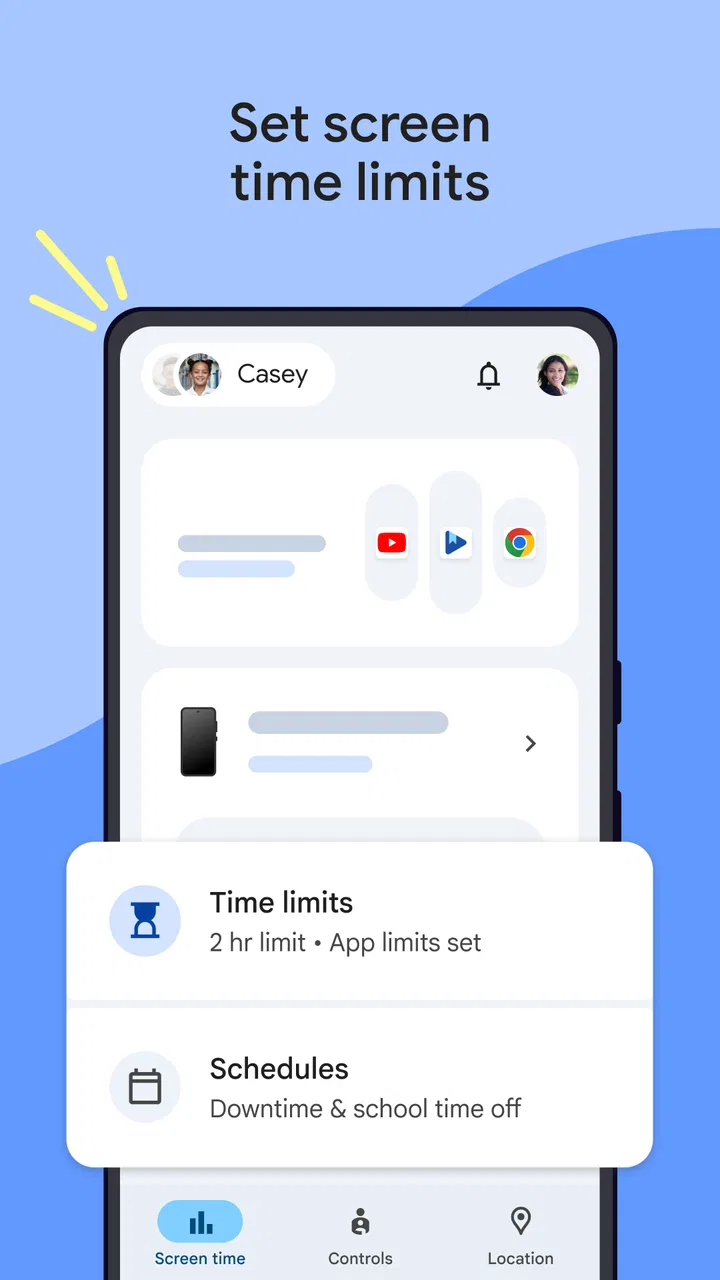
Google Family Link is a parental control app designed to help parents manage their children's device usage. It allows parents to set screen time limits, approve or block apps, and monitor app usage. Parents can also locate their child's device and manage in-app purchases. By linking their Google accounts, parents can ensure a safer online experience for their children.
02Is Google Family Link free to use?
Yes, Google Family Link is completely free to use. The app does not require any subscription fees or in-app purchases to access its features. Simply download the app on your device and your child's device, and follow the setup instructions to start managing and monitoring your child's digital activity effectively.
03What devices are compatible with Google Family Link?
Google Family Link is compatible with Android devices running version 7.0 (Nougat) and higher, and iOS devices running iOS 11 and higher. Parents can manage their child’s account using either an Android or iOS device, ensuring flexibility across different platforms. However, functionality may vary between Android and iOS.
04Can my child disable Google Family Link on their device?
Children cannot disable Google Family Link on their devices without parental consent. The app is designed to be controlled by the parent’s Google account. If a child attempts to circumvent the app's restrictions, parents will be notified, allowing them to address the issue promptly and maintain control.
05What privacy measures does Google Family Link have in place?
Google Family Link prioritizes privacy by allowing parents to manage their child's data and app permissions. Information collected is used to provide the service and is not sold to third parties. Parents can review and delete their child’s data at any time, ensuring transparency and control over personal information.
Pros
- User-friendly interface for easy navigation.
- Real-time location tracking for safety.
- Screen time limits promote healthy usage.
- App approval requests for added control.
- Detailed activity reports for insights.
Cons
- Limited features for teenagers over 13.
- Requires internet connection for tracking.
- Some apps bypass restrictions.
- Initial setup can be time-consuming.
- Notifications can be overwhelming.

Google Family Link
Gallery